• About
  • Contact Us…

Inside-Out, Outside-In

~ Every journey worth taking…starts on the inside.

Inside-Out, Outside-In

Tag Archives: hunter lee hughes

Inside Storyboards…

07 Thursday Mar 2013

Posted by hunterlh in Pre-Production

≈ 1 Comment

Tags

Actor's Director, creating an independent film, Final Image, Final Image Films, hunter lee hughes, independent film, indie filmmaking, inside-out, Is Storyboarding Important?, Monte Patterson, outside-in, Should I use storyboards?, Storyboarding, Storyboards

This week, I began collaborating with filmmaker and storyboard artist Monte Patterson to design the look of “Inside-Out, Outside-In.” Monte just moved to Hollywood from Indiana, emboldened by his successful short film “Caught” and his intriguing film blog “The Final Image,” which already boasts well over 100,000 followers (more on this in another post soon). So I knew I was in good hands as Monte stopped by my office. We flipped open the script and started talking shots.

As an “Actor’s Director,” I know I’m not going to go on the set and think up shots on the fly. Visualizing shots requires me to master a new language beyond the realm of acting and creating narratives, so storyboards become an even more essential way of testing out ideas and working things out in advance. It’s also insurance that I’ll be able to communicate what I want to the cinematographer and other departments. With enough preparation and hard work, your biggest challenge can become your biggest asset (or so I believe. More on owning your own skill set as a director in the next post…). With my skill set, background, taste and ambition, I can’t imagine doing a feature film without storyboards for each and every shot.

I knew I wanted to contain the action in as few shots as possible, both because I don’t see the film as a frenetic, fast-paced film with lots of arbitrary close-ups and to keep camera set-ups to a minimum. Also, it’s important to me that we have fun with the play-within-a-movie motif and to use a little savvy as we employ the illumination provided by the theatre lights.

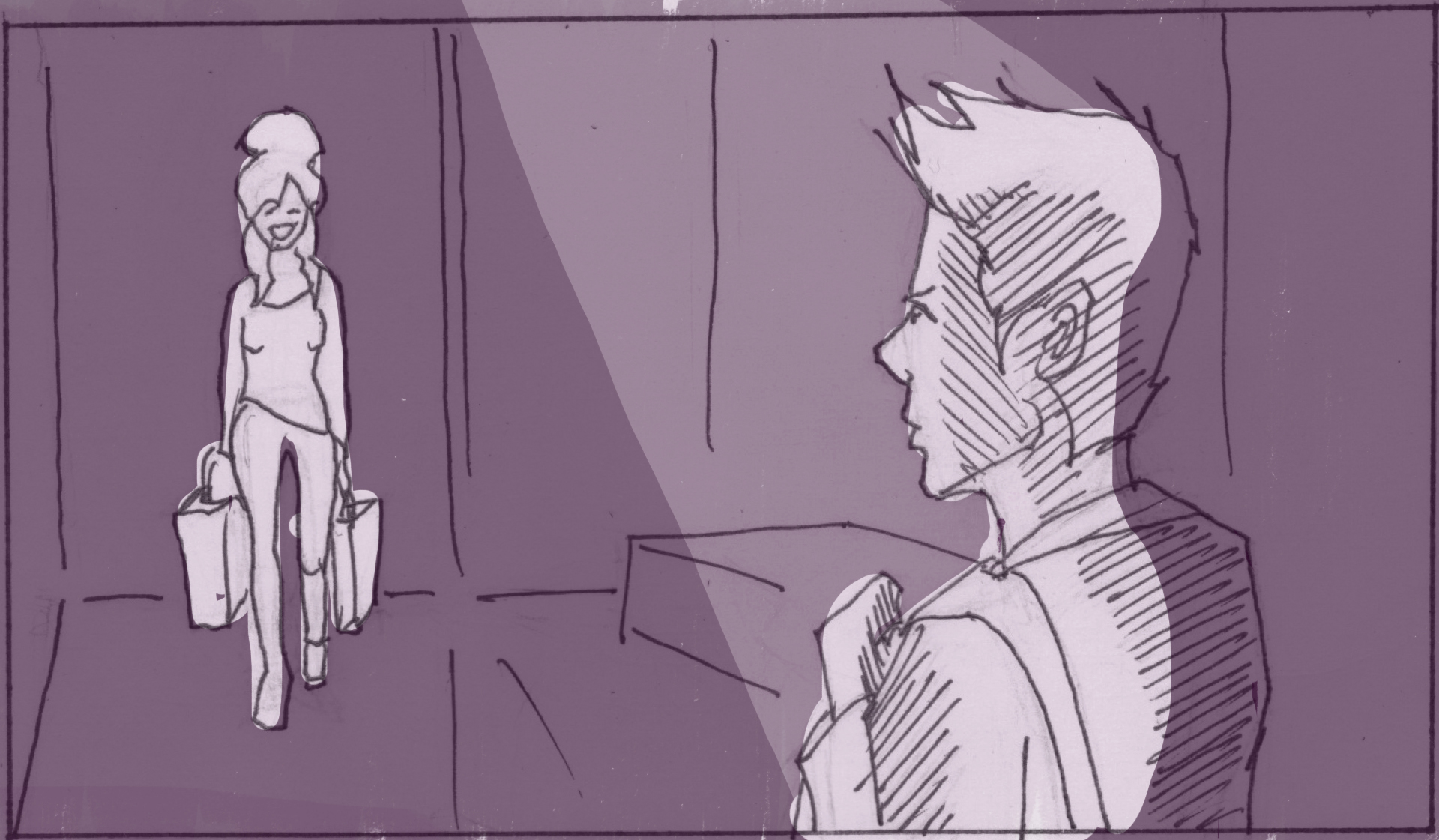
Here are the results of our work together. Monte beautifully rendered two shots from a scene described in a post here. From darkness, stage lights suddenly turn on to illuminate a lone figure standing on stage in a wide shot. We cut in from the wide to see erstwhile performer Nathaniel Quinn enjoying a moment of theatre play, recapturing glory days, only to be “caught” by his producing partner Dorothy as she enters backstage in anticipation of their day auditioning actors.

What we’ve got so far:

Storyboard by Monte Patterson.

Storyboard by Monte Patterson.

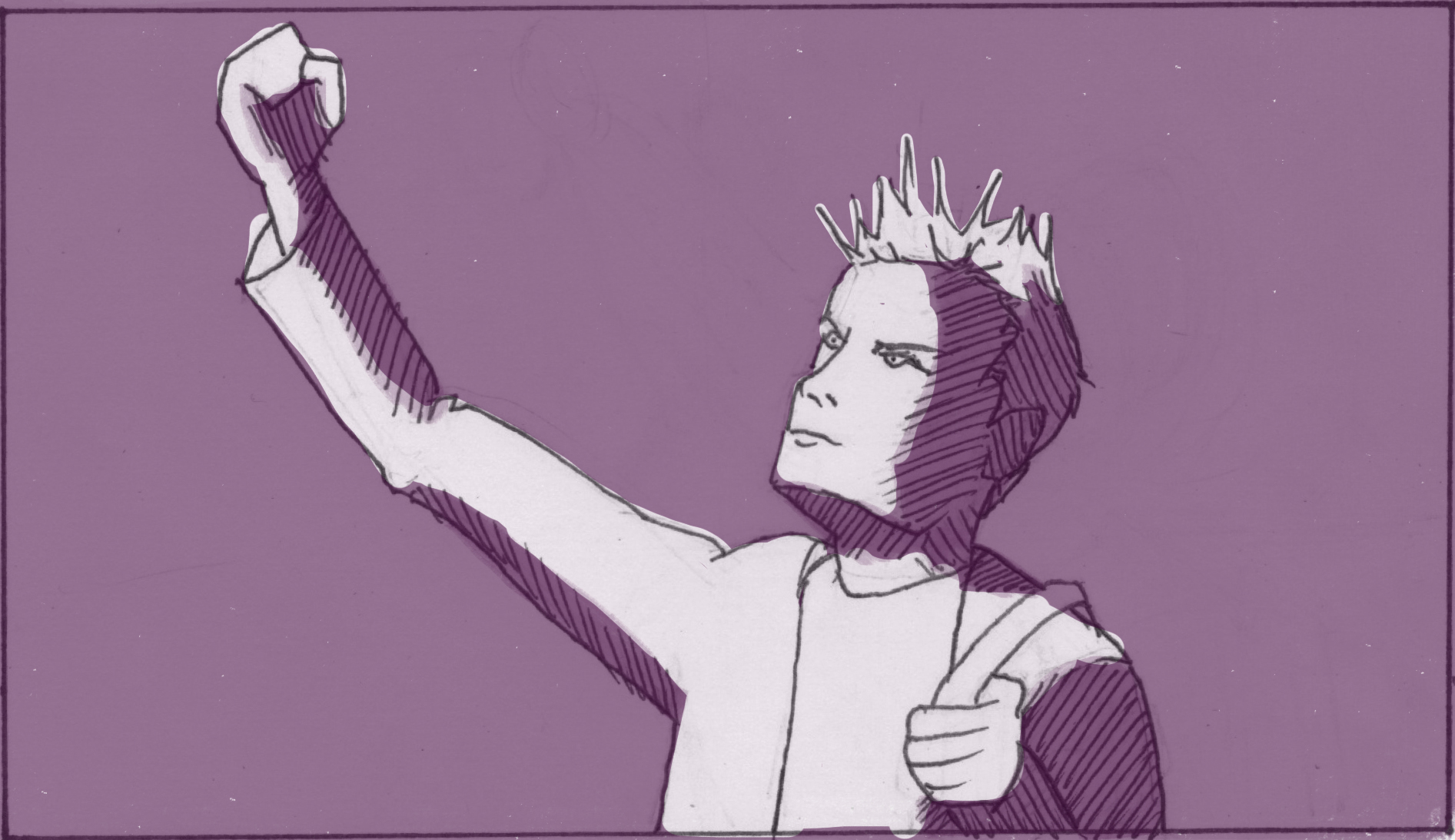
After the punch in from the wide, Nathaniel lifts his fist in mock triumph on the stage and says, “Enter Stage Right. A young man, filled with hope, crosses to the most beautiful girl he’s ever seen.” Nathaniel realizes that his face has softened with tears, feeling the opposite of the sentiment he expressed. From behind him, we hear a woman enter….

Storyboard by Monte Patterson

Storyboard by Monte Patterson

Nathaniel quickly puts his fist down and turns. The camera dollies and pans to reveal Dorothy entering from the darkness of backstage. She says, “Sorry, I’m late.” Nathaniel replies, “You’re not late.”

OK, so I don’t want to give away the whole scene, but that’s enough to give you a taste. Huge thank you to Monte for his beautiful drawings and I look forward to sharing more with you. In the meantime, hope you will check out some more posts about our movie and enjoy Monte’s blog at “The Final Image.”

What do you think of the first storyboards? Ideas? Questions?

– Hunter

—

Hunter Lee Hughes is a filmmaker and actor living and working in Los Angeles and the founder of Fatelink. His current feature film Guys Reading Poems is touring film festivals and this blog is dedicated to the process of making his second feature film, “Inside-Out, Outside-In.” If you enjoy the blog, please support our team by following us on Facebook, Twitter (@Fatelink) or Instagram (@Fatelink).

Share this:

  • Share on Facebook (Opens in new window) Facebook
  • Share on X (Opens in new window) X
  • Share on Tumblr (Opens in new window) Tumblr
  • Share on LinkedIn (Opens in new window) LinkedIn
Like Loading...

Lost Youth Revisited via Don Bachardy Nude Portraits

22 Friday Feb 2013

Posted by hunterlh in Uncategorized

≈ Leave a comment

Tags

don bachardy, hunter lee hughes, nude portraits, paintings in film, portraits of don bachardy, production design, set design, shpetim zero

In 2003, I took a month-long stint as a nude sitter for legendary portrait artist Don Bachardy. He captured the mash-up of my youthful confidence and a burgeoning sexuality still defining itself in the midst of its aesthetic peak. I took the job seriously despite my woeful ignorance of Don’s importance in the art world at the time. But something about the manner of the man, even more than the evidence of his accomplishments hanging all around, jolted an instinct that my earnest cooperation might aid in the creation of something memorable.

Just yesterday, with ten years of aging and life experience under my belt, I arrived once more at Don’s studio inside his idyllic Santa Monica home. The task was to select one of Don’s paintings as a set piece my upcoming film, “Inside-Out, Outside-In,” since the plot of the film includes my character’s history as a nude model in youth. Don generously agreed to the inclusion of one of his real life paintings after a nerve-racking phone call pitch. In preparation for my arrival, Don had laid out fourteen paintings in a square formation on an oversize table with two paintings he clearly favored filling up the center of the square. As I looked at them, I couldn’t help but wonder if my small contribution as a model in his collection of portraits might outlast any and all of my own creative accomplishments in a lifetime. It’s an exhilarating but humbling realization.

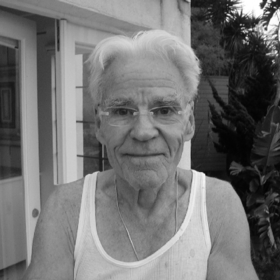
Artist Don Bachardy

Artist Don Bachardy

Back in 2003, Don was in his late 60s, I believe. His stamina and work ethic really stunned me, especially considering the physical strain of his job. We worked eight hour days, with Don creating four paintings a session. A quick ten minute break occurred in between each painting. During the breaks, Don brought out some water and we’d make small talk, although it was small talked charged with the difference in our wardrobe. Some nuggets of information about his process were forthcoming during these breaks. At the time, Don believed in working quickly, creating something, then moving on to the next painting. From our short conversations, it seemed to me that the present moment was of cardinal importance to him and he trusted it more than the desire to perfect or alter something after the fact.

In our case, the nature of the artist and his subject seemed fortuitous. Indeed, Don relentlessly provoked and captured the erotic experiment of a somewhat dangerous young man. I didn’t take the job for the money, although I was well-compensated. Two years after a significant, five-month love affair, I had lost all sense that my sexuality was important, sacred, meaningful. I was uber-resistant to the hookup scene so powerfully seductive in Los Angeles but  when I saw the ad for nude sitters, I sensed an opportunity to explore a powerful latent sexuality that I had no clue how to harness or express. Don sensed this as well, but was either too smart or too kind to acknowledge my motives.

As a novice sitter, Don told me to simply and naturally find a pose, then hold it for two hours or so. I took his direction literally. Once you’ve sat completely still for hours, you realize how often we move our bodies to relieve slight discomfort or just to change things up. When forced to stay frozen, the areas of your body that bear weight tire, then rebel at the increasing physical pain experienced. But, seeing Don’s seventy-something muscles moving the entire time I was sitting was more than motivation enough to “hold the pose” at all costs. So I tolerated some major discomfort without moving, sometimes softly crying as a result of the effort. Sometimes the tears weren’t about the strain on my body.

I remembered those tears when looking at Don’s work. He had included them on some of the faces of the Hunter from so long ago.

My fashion designer friend Shpetim Zero and Don chimed in on which one would be best for the film. It came down to a debate between which pieces interested us the most versus which were most likely to be displayed by the character in the movie. I was torn and unsure, undoubtedly distracted by the sense memory of my life ten years ago. Finally, Don offered to frame and loan me five of the paintings, which was the best result possible, stemming from my indecision or his enthusiasm or both.

Before I left the house, I gave Don a hug and thanked him for the generous loan of his work. But the quality of the hug communicated – hopefully to both of us – that I was thanking him for more than a huge favor in 2013…I was thanking him for valuing my sexuality and erotic sensibility at the moment I needed it most.

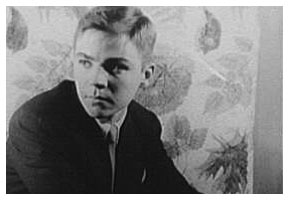
Don Bachardy in youth

Don Bachardy in youth


Hunter Lee Hughes is a filmmaker and actor living and working in Los Angeles and the founder of Fatelink. His current feature film Guys Reading Poems is touring film festivals and this blog is dedicated to the process of making his second feature film, “Inside-Out, Outside-In.” If you enjoy the blog, please support our team by following us on Facebook, Twitter (@Fatelink) or Instagram (@Fatelink).

Share this:

  • Share on Facebook (Opens in new window) Facebook
  • Share on X (Opens in new window) X
  • Share on Tumblr (Opens in new window) Tumblr
  • Share on LinkedIn (Opens in new window) LinkedIn
Like Loading...

Image

Invitation – “Inside-Out, Outside-In”

22 Tuesday Jan 2013

Tags

hunter lee hughes, independent film, inside-out-outside-in, screenplay development, screenplay reading

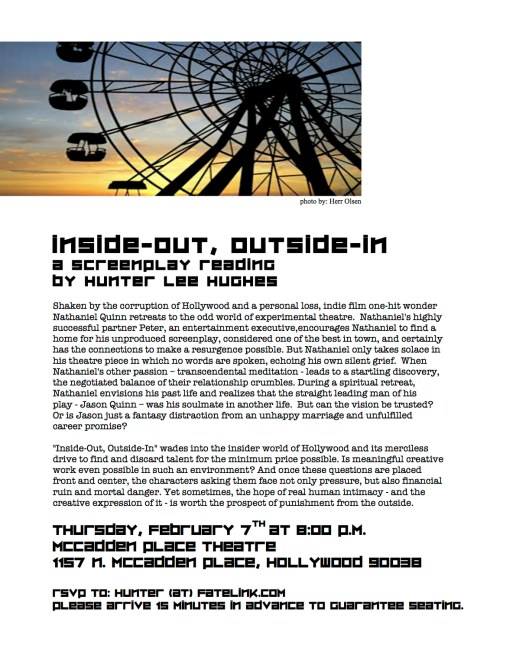
Very excited about our first public reading of “Inside-Out, Outside-In,” scheduled for Thursday, February 7th.

Share this:

  • Share on Facebook (Opens in new window) Facebook
  • Share on X (Opens in new window) X
  • Share on Tumblr (Opens in new window) Tumblr
  • Share on LinkedIn (Opens in new window) LinkedIn
Like Loading...

Posted by hunterlh | Filed under Development, The Script

≈ 4 Comments

Top Ten Things I’m Packing For Sundance

16 Wednesday Jan 2013

Posted by hunterlh in Development

≈ 2 Comments

Tags

fatelink, hunter lee hughes, jason fracaro, jerod meagher, packing for sundance, richard scharfenberg, sundance, sundance trip, top ten things to bring to sundance, what to bring to sundance

Tomorrow morning at 5:30 a.m., I will brew the last of the Christmastime Urth Cafe coffee, pour it into a thermos, pick up my friends and drive the 11 hours from Los Angeles to Park City, Utah for a potentially epic Sundance road trip. Here are the top ten things I’m bringing with me (if I’m forgetting something, tell me now!):

10. Bottled water.  Because I don’t care if bottled water gives you cancer. This weekend, I want to stay hydrated and avoid altitude sickness.

9. My grandfather’s four woolen shirts – Because I want to layer up and strike up some apple orchard memories while in the midst of industry small talk. Keeps you grounded.

8. E-Tip Gloves – Because I want to stay warm and still operate a smart phone at the same time.

7. Cute bathing suit – Because you never know what hot tub parties might send invitations your way.

6. Nine hard copies of ‘Inside-Out, Outside-In’ – Because even when you’re soft selling, you just never know…

5. ‘Dumbass Filmmakers!‘ postcards – Because it’s good to have them set out in the hotel room as a talking point with guests.

4. Thermal Underwear – Because I want to look like Michael J. Fox in “Back to the Future, Part II” and stay warm at the same time.

3. Business cards – Because not everyone has a smart phone and, you know, I may get asked for them every now and then and don’t want to look stupid.

2. Snow Boots – Because they were 50% off at Target and preventing icy, mushy snow from reaching my toes is worth a lot.

1. Wool Socks – Because my grandparents from Ohio gave them to me and again, preventing icy, mushy snow from reaching my toes is worth a lot.

For the record, Team Sundance includes: Jason Fracaro, Hunter Lee Hughes, Jerod Meagher and Richard Scharfenberg.

The next post comes from Utah…

—

Hunter Lee Hughes is a filmmaker and actor living and working in Los Angeles and the founder of Fatelink. His current feature film Guys Reading Poems is touring film festivals and this blog is dedicated to the process of making his second feature film, “Inside-Out, Outside-In.” If you enjoy the blog, please support our team by following us on Facebook, Twitter (@Fatelink) or Instagram (@Fatelink).

Share this:

  • Share on Facebook (Opens in new window) Facebook
  • Share on X (Opens in new window) X
  • Share on Tumblr (Opens in new window) Tumblr
  • Share on LinkedIn (Opens in new window) LinkedIn
Like Loading...

So you’ve raised $2,500. What do you buy first? Filmmaker-distributor Rob Williams discusses DIY indie filmmaking

10 Monday Dec 2012

Posted by hunterlh in Casting, Interviews, Release

≈ Leave a comment

Tags

best investments for a young filmmaker, Black Briefs, Blue Briefs, casting an independent film, Guest House Films, How do i distribute my movie, how do i find a good movie distributor, how do i find an honest movie distributor, hunter lee hughes, independent film distribution, indie film distribution, Men Next Door, Rob Williams

Rob Williams isn’t just a filmmaker, he and his partner Rodney Johnson have created Guest House Films, which distributes movies primarily for the gay audience. I met Rob after they acquired rob williamsFatelink’s film “Winner Takes All” for their “Black Briefs” collection, which went on to hit number one on TLAGay.com‘s sales chart for LGBT titles. Rob talked with us about his new film “The Men Next Door” and about the process of making a film from incorporating to casting to finding the right distributor. And, yep, he answers that question. What should you do with the first $2,500 you raise?

Hunter: You’ve gotten to the promised land of indie filmmaking and by that I mean, you haven’t just directed one film. You’ve directed six! How has the craft and business of filmmaking changed between your first feature and “The Men Next Door“?

Rob: For me, filmmaking has become easier for two reasons – (1) I’ve gained experience on each film, which lets me better anticipate problems and hopefully be more creative with my work; and (2) changing technology makes for easier camera purchase or rental,  software availability, distribution options, etc. And we have spent a lot of time working on building Guest House Films since we shot our first film, and while the business end of it never gets easier, perseverance definitely pays off.

Hunter: I’m beginning to get a little suspicious of aspiring filmmakers who tell me that the only reason they haven’t made a movie is they have no one to finance it. What advice can you give filmmakers to get over that hurdle? Or, with digital technology, is that just an excuse at this point?

Rob: I think the combination of digital technology and crowd-sourced fundraising (such as Kickstarter and IndieGoGo) make it easier than ever to make a movie without any excuses. You can buy or rent a high-quality digital camera for very little money, find actors and crew members willing to work for little or no wages (though I always recommend paying every member of your cast and crew), edit the movie on your computer, and release it online. That’s where the real indie filmmakers are turning these days, and with a little imagination and a lot of hard work, anyone can get their movie made. Now, whether that’s a good thing or a bad thing is another question!

Hunter: Are you functioning as your own movie studio in terms of owning equipment, editing facilities, in-house graphics? How much stuff do you rent/farm out versus keep in-house? And if an indie filmmakers has $1500-$2500 to invest in equipment or software, what would you advise as the first purchase?

Rob: We have always believed in doing what we can do well, and then farming out the rest. For us, that means hiring a good director of photography, editor, music composer, graphic designer and all of the other positions that make a movie stand out, and allowing us to focus on the writing, directing, producing and distribution. But we’ve never really invested in equipment for one reason – technology changes incredibly fast. That amazing HD camera that costs $2,500 today might be completely obsolete in a year or two. My advice to an indie filmmaker with that amount of start-up capital would be to find a good attorney and use that money to incorporate their business and get the basic legal paperwork done so that they can move forward with building their brand.

Hunter: How do you keep the casting process streamlined and efficient? Casting is one of those things that a lot of indie filmmakers don’t budget for – they figure it’s two days borrowing an office and buying some doughnuts for the guy helping you video the auditions. But if the casting process takes a month…well…that gets expesnsive, right? Time is money. How do you keep on track?

men next door

Michael Nicklin, Eric Dean & Benjamin Lutz in “The Men Next Door“

Rob: Casting should never be an expensive process. We keep track of actors we like, and if there is an opportunity to work with them, we’ll try to bring them in. It’s much easier to find an actor you like and who is good, and approach them directly, than to hold a huge cattle call. But if we have to, we post on online casting sites, carefully comb through submissions and keep the audition process to a minimum. And if that doesn’t work, we ask fellow filmmakers – referrals are the absolute best way to find good actors. If another director or producer can vouch for someone’s talent and work ethic, that goes a long way with me.

Hunter: Of course, as an old school romantic, it seems totally awesome that you make movies with your partner Rodney at your side. Is it fun to be able to develop as a filmmaker with someone you care about so much?

Rob: Absolutely! It’s great that we have been able to start our company together, work together to make it grow, work on each film together and share in the rewards. We are both passionate about filmmaking and dedicated to producing the best films we can.

Hunter: You and I have talked a little bit about the evolution of LGBT film. Are you seeing any trends in how the films are maturing? Or are they maturing at all? Should a young LGBT filmmaker still make his “coming out” story if that’s what moves him? Or are certain stories deemed too “passe” and others “hip”?

Rob: It’s tempting to say that we’re moving into a “post-gay” world of filmmaking, where the characters’ sexual orientation is irrelevant. But that’s just not true, especially for people like me who want to make gay-themed films. Hollywood films may incorporate more and more gay characters in a nonchalant way, but indie gay films are made for the gay audience. Our viewers want to see their lives reflected onscreen (or perhaps see what they wish their lives would be). I wouldn’t ever tell a filmmaker to stay away from any particular genre, because we need filmmakers to tell stories that are important to them, that move them and that could resonate with their viewers. Sure, coming-out stories have been done to death, but if someone has a fresh take on it, they should go for it. Good storytelling transcends genre.

Hunter: You’ve now branched into distribution with the “Black Briefs” and “Blue Briefs” collections of gay shorts. (And we’re especially grateful since it includes our own “Winner Takes All”). How did this bridge to distribution happen for Guest House Films and why did you feel it was important? Is being a distributor more or less fun than the producing?

Rob: After dealing with distributors for our first four films, Guest House Films made the decision to get into distribution with our fifth feature film, “Role/Play,” taking advantage of the relationships we had built over the years and the increasing ease with which filmmakers can get their own products out to the public. After the success of “Role/Play,” we saw an opportunity to get other people’s films out there, particularly short films. There are so many amazing gay-themed short films produced every year, and so few ever get seen outside of film festivals, and we’re glad we can help filmmakers get their work seen. It’s a lot of work, but it’s also very gratifying to see these great films reach a wider audience.

Hunter: I know and many others in the community know your reputation for honestly caring about LGBT filmmakers and being honest in business, which is amazing in a field rife with piracy and “creative accounting.” What are the biggest ethical pitfalls that young filmmakers face and what are some strategies for staying true to yourself?
black briefs

Rob’s collection of dark short films landed on the top of TLAGay.com’s sales chart in 2012.

Rob: The biggest pitfall young or first-time filmmakers encounter is accepting the first offer they receive or not doing their research about distributors. Before signing anything, filmmakers should ask around and find out exactly what they’re getting into. If they want to stay true to themselves and to what they want to do, they should focus on developing good scripts and finding good actors, and then simply make the movies they want to make. Don’t let anyone tell you what you should or should not make – create the movies that mean something to you, and that will make it resonate with others.

Hunter: Thanks for your time, Rob. I think it’s exciting that you’re going all the way with DIY and distributing product yourselves, making more money on your own films and providing a platform for newer artists to gain exposure and a financial foothold in the market. 🙂

—

Hunter Lee Hughes is a filmmaker and actor living and working in Los Angeles and the founder of Fatelink. His current feature film Guys Reading Poems is touring film festivals and this blog is dedicated to the process of making his second feature film, “Inside-Out, Outside-In.” If you enjoy the blog, please support our team by following us on Facebook, Twitter (@Fatelink) or Instagram (@Fatelink).

Share this:

  • Share on Facebook (Opens in new window) Facebook
  • Share on X (Opens in new window) X
  • Share on Tumblr (Opens in new window) Tumblr
  • Share on LinkedIn (Opens in new window) LinkedIn
Like Loading...

Version 2.0: The Second Screenplay Reading

06 Thursday Dec 2012

Posted by hunterlh in Development, The Script

≈ 4 Comments

Tags

Ann Russo, bossa nova, Charles Hoyes, friends, gaydar, how to do a screenplay reading, hunter lee hughes, jason fracaro, Jeord Meagher, Luke Massy, making movies with friends, revising your script, rewriting, rex lee, screenplay reading, Screenwriting, story analysts, Tracey Verhoeven, Whitney Anderson

An intimate, elegant screening room fittingly served as the locale for our second reading of “Inside-Out, Outside-In”, unconsciously expressing the ethos and hopes of the project. At first scheduled for the more grand space on the 5th floor, I decided to relocate our reading downstairs so my WeWork colleague Kristin Nedopak could more easily access the 5th floor screening room to celebrate the release of her webseries, “Skyrim Parodies.” At first obstinate over a change requiring more emails and a slightly smaller room, I relented. After all, the number four is the number of spiritual wholeness and maybe a bit of good luck might follow a bit of a good deed. Turns out, the fifteen actors and three invited guests fit perfectly into an imperfect circle of chairs of differing sizes, styles and fabrics.

Like all readings, despite my best efforts, we started late. Still, as director, I felt is was my responsibility to properly frame the evening and send us in the right direction. So I somewhat awkwardly told our group that the script was intensely personal to me, hoping that such a revelation would increase the chances that they would also bring an intensely personal approach to the night. Building on that notion, I asked the actors to let go any sense of a “professional veneer.” Lately, I find the acting in studio films so boring because a sense of the actors’ professionalism prevents me from relating to them no_egoas human beings.  They almost know the beats too well – it’s like watching an emotionally resonant cuckoo clock. Even at an early stage, I didn’t want to see that happen to my actors. So I suggested they see the reading as a “practice round” and encouraged them to just be a human being in a situation, not a professional actor at a reading.

Just before we dove in, television’s Rex Lee once again blurted out a quote of the night, “Is that buzzing, like, going to go on for infinity?” Apparently, a smoke alarm needed more acknowledgement than a roomful of actors and went off with annoying regularly throughout the reading. But something amazing about a good story and good acting – once we got past page 10, I didn’t hear the buzzing anymore and not because of a decrease of its decibel level.

I’d made a number of changes in the cast of the reading – about half the people were new. Sometimes, it was a result of a desire to try a new angle with the character, sometimes a scheduling conflict forced a change. Also, my friend Zsa Zsa Gershick, an accomplished playwright and director, previously implored me to see different people in many of the parts before settling on someone, as part of the process of understanding the character as deeply as possible. Indeed, the fragility of casting and character development pervades my thinking at the moment – add a few years to this character’s age and another character needs to be younger. If we go with a more quirky sensibility for one character, it requires a different character to step up as an authority, changing the requirements for the actor playing him.

An interesting addition to the evening was Jerod Meagher, an unrepresented actor just starting out at Ivana Chubbuck’s studio, where so many of us have trained. He stopped by the office a few days before the reading in hyper-ripped jeans to get some direction on the Jerod Meagher, actorcharacter. I immediately liked that he took notes with a pen and crudely folded piece of paper rather than an iPhone or some other secondary device. It’s a good thing if notes are fragile enough to be lost. He apparently made a good impression on at least four female attendees whose comments after the reading ranged from, “He’s got something” to “He’s sincere” to perhaps the most powerful – “I don’t know, I just like Jerod.” The ever-quirky and entertaining Tracey Verhoeven went a step further and said, “He’s just like a little angel. I mean, not like one of those fat cherub angels but like a good-looking one.” Also new this time were talented veterans Whitney Anderson, Luke Massy, Ethan Rains whitney aand Charles Hoyes. Whitney, who recently forwarded my acting reel to a director for a mind-bending fright flick for the role of a juicy psycho guy, is one of the most helpful people to know in terms of making recommendations. She’s savvy about seeing when colleagues might be a good fit and has no problem connecting them, a refreshing attitude in this town.

Afterwards, the approval of the adjustments I made to the script were heartening and the discussion turned more to “which way to go” with certain characters and practical concerns for the shooting rather than folks suggesting major overhauls. I even got one, “It was fuckin’ awesome” from a guest. That felt good. I am still worried about the climactic scene being too talk-y and Ann Russo echoed that concern. But we both felt the visual element of the choreography in that section might compensate for a dialogue-heavy stretch. Ms. Russo easily could’ve been a colleague of mine as a story analyst. She consistently airs notes that my foggy unconscious hasn’t yet articulated, so I was especially grateful for her feedback throughout the night on characters, plot and pre-production. There’s always a chance people are holding back their doubts out of respect or fear, but I now feel confident enough with the script to go ahead and create a shooting script to schedule the film and start getting more detailed with the budget.

Speaking of budget, the one startling bit of feedback came from high fashion designer Sphetim Zero, who passionately declared that he would need $50,000 to properly costume the feature. I appreciated his ambition, but warned him that was impossible with our current budget constraints. He encouraged me to open myself up to receiving more from the Universe. I agreed to be more vigilant about hoping for the best, but warned him to think of a back-up plan. We both agreed that he would help me clothe people from their closets for the industry read in February and take it from there.

Once again, a core group ended up at Bossa Nova for late night steak. This time, Dumbass Filmmakers! producer Jason Fracaro joined myself and aspiring social media guru Richard Scharfenberg (more on this effort in a future post). Jason, back from a 10-week basic training for the Army and his inclusion in the National Guard, has a reputation as one of the best guys to know (and one of the worst gaydars – ask me privately) and he gamely filled our quota for at least one “straight guy” at the dinner. Rex arrived late and this time, we were able to order his “ribeye steak cooked ‘medium rare plus’ with plantains, extra pico de gallo, extra salsa” before he arrived. But, just like last time, he paid for all of us with the quick move of a credit card and a declaration that, “I don’t believe in splitting checks.” He’s one of those guys that picks up the check when it’s kinda expensive or a big group and lets you return the favor at a hamburger joint. Ah, friends.

Correction: Ah, friends…and filmmaking.

Cast of the 2nd reading of “Inside-Out, Outside-In” (in alphabetical order): Whitney Anderson, Camille Carida, Marilyn Chase, Jason Fracaro, James Lee Hernandez, Charles Hoyes, Hunter Lee Hughes, Marcus Kaye, Rex Lee, Luke Massy, Jerod Meagher, Ashley Osler, Ethan Rains, Ann Russo, Tracey Verhoeven. Invited guests included Mr. Richard Scharfenberg, Mr. Jay Walters and Mr. Sphetim Zero.

—

Hunter Lee Hughes is a filmmaker and actor living and working in Los Angeles and the founder of Fatelink. His current feature film Guys Reading Poems is touring film festivals and this blog is dedicated to the process of making his second feature film, “Inside-Out, Outside-In.” If you enjoy the blog, please support our team by following us on Facebook, Twitter (@Fatelink) or Instagram (@Fatelink).
Share this:

  • Share on Facebook (Opens in new window) Facebook
  • Share on X (Opens in new window) X
  • Share on Tumblr (Opens in new window) Tumblr
  • Share on LinkedIn (Opens in new window) LinkedIn
Like Loading...

Halloween: The Soul Revealed through Costume, then Squashed

01 Thursday Nov 2012

Posted by hunterlh in Development, The Script

≈ Leave a comment

Tags

analyzing halloween costumes, Da-Sein, existential messenger of death, existenZ, halloween, Heidegger, herd instinct, hunter lee hughes, karl jaspers, robin as a halloween costume, Script Development

It doesn’t take a social scientist to recognize that a Halloween costume is rarely just that. It’s not random. People must select, on some basis, what they will wear for Halloween. No where was this phenomenon more on display that at the annual Halloween festivities in West Hollywood, probably the single best attended event in the city (with perhaps Pride in June as a close competitor). In the gay world of WeHo last night (which by the way was at least 60% straight), Halloween was a High Holiday and the most common costume was that of Robin, sidekick to Batman. I also saw couples having fun with the concept of “twinning” – both dressing up as prisoners, both as cave men and, in one case, both dressing up as zombies with ‘sex for brains.’ There were some couples that had related but opposite costumes, such as Devil with Angel, Cop with Criminal, Master with Slave, etc. One wonders if these are the accurate psychic representations of the relationship or if they are toying with inhabiting the opposite role for a night (a friend told me he’d once dressed up as a slave to a dominatrix when in fact he held all the power in the relationship). But either way, the selection of the costume means something about who you are and your relationship to your self and others (Know that whenever you are at a Halloween function, psychologists and artists are having a lot of fun looking into your subconscious). Some people are relieved from the stress of choosing to represent themselves as an individual and dress up as whole groups – there was one group of friends that dressed up as the Scooby Doo clan and another group that all dressed up as Waldo from the ‘Where’s Waldo?’ posters. Then, there are those that create or select something that is their costume alone – whether a witch or zombie or fairy or something else of their own creation (inspired by my existentialism class, I wore a black suit, black shirt, red tie, black mask, carried my textbook and went as an ‘Existential Messenger of Death’). And, of course, there are those that choose to wear no costume at all, which in and of itself is another interesting choice. You cannot say nothing about yourself on Halloween, like it or not.

That’s what is truly eerie about Halloween – it’s an opportunity to reflect unseen layers of our psyche for ourselves and others to see. But this potentiality is so powerful that the herd instinct in us rises up to prevent Halloween from its illuminative potential and turns it into the most mundane and meaningless holiday of them all. It starts out as a curious conundrum for the psyche and turns into a boozing mass of conformists confronted with one makeshift hot dog stand after another, all selling the same thing.

There’s an argument to be made that a Halloween costume reveals our own ExistenZ’s struggle to express itself. Karl Jaspers describes ExistenZ as the being inside that fights against “mundane being.” From my understanding, it’s the authentic, transcendent self that takes its cues not from the world and the demands of the world, but from its own essence (a force for the purposes of my movie that I will describe as “Inside-Out”). Maybe it’s the tricky psychic force within that inspires you to dress up as Peter Pan for Halloween in the midst of your Puer Aeternus complex (so you might get a clue). But another powerful force is at work on Halloween. Nietzsche and a host of others identified the concept of a “herd instinct” which some, like Martin Heidegger, believe also exists in some form within each individual whether they are currently engaging with a herd or sitting by themselves (a force for the purposes of my movie that I will describe as “Outside-In”). Maybe it’s the powerful messaging you receive to be like your peers that compels you to gather en masse, drink, have fun and observe the unspoken social contract of what it means to enjoy a Halloween festival.

Heidegger argues that the primal potentialities of the soul are “leveled down” by idle talk and concerns of people on a “group level.” An individual’s instinct to subject itself to the mentality of the herd mitigates the fear of that person’s inward ExistenZ potential…and its impermanence. The herd instinct most fears death. It is something that is processed on a group level that protects the group from processing impermanence on a soul level. The herd tells you what to do when death occurs, but it allows you to avoid associating it with your own eventuality. As Heidegger explains, death happens, but in a strange way it doesn’t happen to you when you’re in the herd. It might sound nice to be protected from the reality of death, but the herd also protects you from considering how your own death might change – and even liberate – your life with all its potential.

Now, back to Halloween…so just when your ExistenZ bubbles up to the surface and demands you choose a ridiculous costume because it desperately wants to show you something about yourself that you simply can’t see, the herd instinct swells with its zombie-like message from the outside: drink, drink more, friends, idle talk, bullshit, HOT DOGS!, other friends, drink, sex, sex, sex, sleep. It is a slumber that costs the transcendent lesson that the ExistenZ made available through the selection of the costume in the first place. It is a slumber that keeps at bay ExistenZ and the reality of our own death…during a holiday that supposedly highlights it.

And so I walked into West Hollywood last night as the “Existential Messenger of Death,” selecting someone in the crowd, usually someone not wearing a costume, that I would then stealthily approach and say, “Happy Last Halloween. End of Days is here. You have been Chosen.” Then, I would walk away, just slowly enough to see either a mocking insolence or disturbed agitation register on their face.

I saw it as my responsibility to inject the idea of Death back into Halloween. People deserve some Dread. Not just because death is part of Halloween, but because feeling the angst of death is the best hope that an individual will throw off their herd mentality and turn towards the inner potential waiting for them to create a uniquely amazing life.

My movie is currently titled, “Inside-Out, Outside-In.” But when you see it (sometime in 2014 with any luck) I hope it might earn the reputation of, “Existential Messenger of Death.”

This essay is the third in a series on the themes of “Inside-Out, Outside-In.” The first two are available on the site and include, “Is Cool cool? Reflections on the New Religion” and “Mutual Self-Interest vs. Love (and why Dr. Phil and Oprah have it wrong).”

—

Hunter Lee Hughes is a filmmaker and actor living and working in Los Angeles and the founder of Fatelink. His current feature film Guys Reading Poems is touring film festivals and this blog is dedicated to the process of making his second feature film, “Inside-Out, Outside-In.” If you enjoy the blog, please support our team by following us on Facebook, Twitter (@Fatelink) or Instagram (@Fatelink).
Share this:

  • Share on Facebook (Opens in new window) Facebook
  • Share on X (Opens in new window) X
  • Share on Tumblr (Opens in new window) Tumblr
  • Share on LinkedIn (Opens in new window) LinkedIn
Like Loading...

Mutual Self-Interest vs. Love (and why Dr. Phil and Oprah have it wrong…)

30 Tuesday Oct 2012

Posted by hunterlh in Development, The Script

≈ 1 Comment

Tags

cupid and psyche, dr. phil, he's not that into you, hunter lee hughes, love as a kidnapping, mutual self-interest vs love, oprah, oprah winfrey, petrarch, petrarch and laura, plutarch and laura, self-esteem and love, she's not that into you, the difference between love and mutual self-interest, what is love?, William-Adolphe Bouguereau

This is the second post in a series on the themes of “Inside-Out, Outside-In.” The first in the series, “Is Cool cool? Reflections on the new Religion” is available to read here.

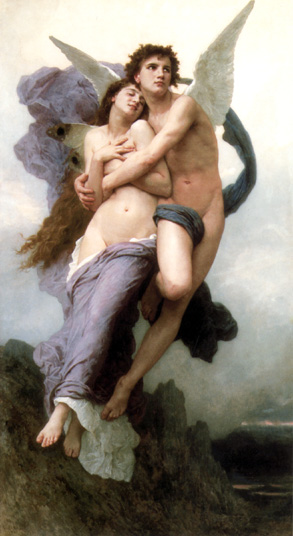
For years, “Cupid and Psyche” by William-Adolphe Bouguereau hung in between two lonely windows of my studio apartment in Koreatown, somewhat inappropriately overlooking a bus stop, a Korean evangelical church and gang activity which eventually claimed a coin collection inside my apartment. The print made the move with me to the Valley and then to West Hollywood but was eventually (appropriately) stolen (or liberated?) from my parking spot storage area. I hardly blame the thieves on that one.

Cupid abducts Psyche.

After all, romantic love deserves better placement than a makeshift, open air garage. Despite my carelessness with the iconic image, I do consider myself a bit of a romantic…and boy are we in need of some warriors of love to defend against the onslaught of modern-day rational prophets that no longer trumpet love…but rather a concept I call “mutual self-interest” masking as love.

The worst offenders of this aggressively self-interested philosophy are Oprah and Dr. Phil, although I’ll focus on Dr. Phil since he’s the one still in major syndication. One can only imagine what would transpire should Petrarch, resurrected from the Beyond, end up appearing on “Dr. Phil” to talk about his beloved Laura. No doubt, Dr. Phil would set Petrarch straight right away, “She’s not that into you! Get over it!” might be his candid advice and undoubtedly he would follow it up with the penetrating psychological question, “What makes you so drawn to unavailable women?” If Dr. Phil succeeded in getting Petrarch to “see the light” we might miss out on some of the most heartbreaking, clear-sighted poems chronicling the human capacity for connection, ecstasy and pathos. So, with any luck, Petrarch, no doubt a more interesting, thoughtful man of gravitas than Dr. Phil, would simply reply, “You’re wrong. I love her.”

And we might add that Petrarch’s love for Laura, despite her inability to return his love at the same level, gave his life meaning…and ours. Petrarch’s steady, inspiring dedication to Laura seems crazy because we no longer value love for love’s sake. We seek to build romantic relationships based on mutual self-interest. And if a dash of feeling and hormones are thrown into the equation, all the better. But a divorce, decay or the like is sure to follow with these unsteady arrangements as soon as the other person starts behaving in a way that contradicts their partner’s self-interest. Then, man, that other person has to start behaving differently…right away…or they have to go. After all, my self-esteem isn’t gonna take this bullshit! (Here, Petrarch would smile wistfully and say, “Go home and think it over, boy.”). In short, we only want to let out a bit of “love” when we know it’s completely “safe” within the construct of a mutually self-interested relationship.

Let’s define terms a little better. What is a relationship of mutual self-interest? It looks something like this. Man, I’m so attracted to that person! They turn me on. And they’re an up-and-comer in this career field I admire. Wow. That’d be cool to be a team with a person like that. We’d look hot together at a company party and bring in two incomes – so helpful in the big city! The sex is good. I’m getting off and so is the other person. Plus, the person gets along with my family, which is cool. That’ll make things easier when we bring up kids. And we have a pretty good personality match. The other person doesn’t annoy me too much and vice versa. And the person gets along with my friends, so I don’t have to worry about huge drama on that front. Hey! Damn! I’m checking off so many boxes of my “Requirements for a Relationship List” with this person. I’m in!

Is it really so bad to build a relationship based on mutual self-interest? I think so, but others could argue that it’s practical. Your mutual self-interest relationship can help you advance in the world. Your mutual self-interest relationship can facilitate the building of a home and nest egg. Your mutual self-interest relationship protects you from feeling “less than” or “insecure” because you’ve both agreed equally to this mutual self-interest relationship. And your mutual self-interest relationship protects you from feeling the full onslaught of loving feelings for another human being without a sense (however false) of security.

Real love has nothing to do with security. It is a kidnapping in the night. It requires ascension to the heights of Heaven with an unknown creature followed by a descent into the depths with little chance of survival. It is a story of togetherness and loss and togetherness again. At the moment you really see the true soul of your beloved, the risk of sabotage is almost cruelly high (as happens to Psyche when she realizes she’s been kidnapped by an immortal beauty rather than the monster she feared). But the fulfilling moments of love are so awe-inspiring and real that they merit Psyche’s trip to the depths of Hades, where Cupid’s subtle guidance leads her back into his embracing arms. Real love is rocky, almost certainly untenable…almost. It is for the brave. It is for the stupid. It is for the exceptional…and theirs alone to claim when won. But even when the love is lost, as happened to Petrarch, yours is the victory of a life made meaningful and clear despite suffering. You are enriched by the acrobatics of the soul, juggling to stretch and grow enough to pass the rigorous test that love throws down.

Build a mundane relationship based on mutual self-interest if you like. I’m sure Dr. Phil and Oprah would applaud. It certainly makes sense to do so. A relationship based on mutual self-interest certainly creates a bond of materialists that helps you to face the world…for a time.

But only love, that old thief of all things rational, creates your character and unleashes your soul…to your beloved and to everyone that matters. Go for love – I dare you.

—

Hunter Lee Hughes is a filmmaker and actor living and working in Los Angeles and the founder of Fatelink. His current feature film Guys Reading Poems is touring film festivals and this blog is dedicated to the process of making his second feature film, “Inside-Out, Outside-In.” If you enjoy the blog, please support our team by following us on Facebook, Twitter (@Fatelink) or Instagram (@Fatelink).
Share this:

  • Share on Facebook (Opens in new window) Facebook
  • Share on X (Opens in new window) X
  • Share on Tumblr (Opens in new window) Tumblr
  • Share on LinkedIn (Opens in new window) LinkedIn
Like Loading...

Accepting your personal Steppenwolf

27 Saturday Oct 2012

Posted by hunterlh in Development, The Script

≈ Leave a comment

Tags

bourgeoisie, existentialism, finding yourself in your characters, herman hesse, hunter lee hughes, revising a script, soulsearching, steppenwolf, writing as a hobby, your writing as your soul, zsa zsa gershick

In reading an excerpt of Herman Hesse’s “Steppenwolf” for my audio c.d. Existentialism course, I’m struck by how much of the creative process is accepting your own inner beast with all its variety. Hesse describes a man-beast, who despises the bourgeoisie life of reporting to an office and refuses comfort from the salient symbols that satisfy the more childlike and demure personalities of a culture. And yet, the man-beast is never satisfied because when he unleashes the primal raw energy of his fury and sexuality, the man side of him disapproves of his cruelty, his animalistic crudeness and his lack of faith in the goodness of others. But when the man side takes over, the wolf within mocks the man’s hypocritical, clumsy attempts at goodness which are rarely more than masked self-interest. And so the Steppenwolf wanders – outside of society, at war with himself, at risk of self-destruction.

Certainly, I relate to the struggle of the Steppenwolf. I never trust artists who report to a nine-to-five and find they are rarely more than hobbyists hoping for a promotion that will never materialize. To live the life of an artist, you have to risk something. You have to step into an unsafe wildnerness all alone. You have to reject something that makes sense to almost everyone else. And you have to live with the suffering that, indeed, you may fail. That is the greater likliehood. You must endure watching others make steady progress in the world while you scavenge for hidden beauty that others won’t see. They probably won’t see it even after you’ve found it against all odds and hold it up to their face. They will say you are holding thin air. But if you are a Steppenwolf, what choice do you have?

But Hesse isn’t so cruel as to provide a penetrating observation without a solution…or at least some hope. For him, the Steppenwolf’s salvation comes when he realizes that he is not just man and beast, but (to paraphrase) man, beast, butterfly, flower, stream, brick castle, poverty-stricken child and bourgeoisie banker all rolled into one. The mistake of the Steppenwolf is in seeing himself as divided in two. Actually, he is divided into infinite.

And so, reading Hesse, I have realized something about “Inside-Out, Outside-In.” A few days ago, playwright Zsa Zsa Gershick implored me to search for myself in all the characters. I took the advice to heart and have been mindmapping to better understand the humans that populate the story. Hesse and the Steppenwolf admonishes me to go one step further and see the script as a reflection of the fragments of my soul that come together as one complete universe in the script itself. The longing for unity that drives men to destroy themselves can only be satiated when these variegated parts come together in a satisfying arrangement, for which there is no math to determine. Simply accepting the infinite aspects of my own psyche and allowing them to orchestrate themselves will be enough. The script is not so much a war between various sides of myself, but a chance for them all to show up and dance together. It only looks like a battle because, well, for most of us, we lose touch with the reality of the Steppenwolf so quickly and so often that inevitable inconsistencies and paradox always look like war.

—

Hunter Lee Hughes is a filmmaker and actor living and working in Los Angeles and the founder of Fatelink. His current feature film Guys Reading Poems is touring film festivals and this blog is dedicated to the process of making his second feature film, “Inside-Out, Outside-In.” If you enjoy the blog, please support our team by following us on Facebook, Twitter (@Fatelink) or Instagram (@Fatelink).
Share this:

  • Share on Facebook (Opens in new window) Facebook
  • Share on X (Opens in new window) X
  • Share on Tumblr (Opens in new window) Tumblr
  • Share on LinkedIn (Opens in new window) LinkedIn
Like Loading...

From the mouths of actors….the first reading.

23 Tuesday Oct 2012

Posted by hunterlh in Development, The Script

≈ Leave a comment

Tags

alessandro piersimoni, bohemian lifestyle, developing your screenplay, hunter lee hughes, inside-out-outside-in, justin schwan, rex lee, screenplay readings, shon perun, should i do a reading of my screenplay, themes in screenwriting, thy will be done prayer, zsa zsa gershick

“Help us to see what we need to see, hear what we need to hear. Thy Will, not ours, be done,” is my best paraphrase of the prayer spoken by accomplished playwright and filmmaker Zsa Zsa Gershick to kick off the first reading of “Inside-Out, Outside-In.” (more on the title later).

I’ve written four feature length screenplays before. None of them have been produced. This time, I wasn’t taking any chances and wanted from the start to invoke a higher purpose for the material, especially since the tension between ego-driven and authentic, soul-driven choices provides the core conflict of the movie.

The reading took place at the 5th floor screening room at my communal office. Television’s Rex Lee quickly voiced the question on many minds, “Is this going to be the temperature setting for the whole night?” I looked anxiously at the locked thermostat. I knew a key card wasn’t going to cut it with that thing. What we wouldn’t be hearing was the whirring of an AC at work. Justin Schwan, reading a lead role, shed a modern-day, professorial grey button-down sweater, preferring a white tank top, but Zsa Zsa (in a tailored suit) and Ashley Osler (in a cream, fluffy turtleneck sweater) weren’t so lucky. It was hot.

But whatever discomfort the heat provided did not arrest our progress through the script. I felt torn between the focus on my own role and marveling that living human beings were embodying characters that began as notions, developed into imaginary conversationalists and, now, met with flesh and blood.

Readings help to reveal how the structure of a piece is working and, on that score, I’m beyond pleased. They also spark challenges to identify the really important aspects of a character – whether you’ve pegged the guy at the right age, the right sexuality, the right archetype. Here, some adjustments will occur. They also start to indicate the range of reactions from an audience. I learned long ago not to attempt to please all segments of the audience and sucking up to the mainstream is anathema to my quirky humor and homoerotic sensibilities. But still, it’s helpful to know which characters they wanted to know better, who makes a shift in behavior that takes them by surprise and assess the universality of the piece. I consider my niche to be creating a surprising universality through characters usually overlooked or stereotyped and feel this script is in alignment with my own authenticity. So I felt grateful that many of my friends voiced support for the script as a success or on the road there.

“I don’t like the title,” said one of the most interesting guys I know in Los Angeles. Alessandro Piersimoni gave up a lucrative career in advertising to pursue filmmaking in Los Angeles and so far has found some success as an actor, appearing in David Fincher’s “Girl with the Dragon Tattoo.” His eye for aesthetics surpasses my own, although my innate if somewhat downplayed competitive spirit challenges me to catch up.

“The title doesn’t do anything for me. Maybe shorten it to ‘Inside-Out’ or change it to something else. Other than that, you’re 99.9% done. Just take it to the literary agent and say, ‘Here.'” He mentioned two or three other problem areas and encouraged me to just get on with it. Compliments from those with developed sensibilities really mean something and I relished Alessandro’s words as something hard-earned and real.

Once the reading broke up, some of the guys, including Justin, the talented and underused Shon Perun and Alessandro enjoyed a beer. Like Christmas coming early, Justin couldn’t believe a professional office would feature frosted mugs in the freezer and beer on tap, but the quirky Tracey Verhoeven was a little late to the party and had to settle for a plastic cup.

Zsa Zsa and her erudite wife Elissa closed it down, talking to me another half hour about the script, its theme and their own experience casting and refining the scripts for Zsa Zsa’s projects. Zsa Zsa generously tried to sum up her playwriting degree in a few minutes and boiled it down to, “Know the theme. Make sure everything supports that. Write your character bios and find yourself in ALL of them.” Elissa, like a big sister, asked if I parked close or if they should wait and walk me to the car.

Soon after, Rex and Richie, an adorable 26-year old techie hipster-who-denies-he’s-a-hipster, texted me. They ordered me to drive to Bossa Nova on Sunset, where they’d ordered me a steak that was on its way. I showed up as the waiter brought my food to the table and noticed the guys had already eaten and their plates had been cleared. Ah, friends. A lovely discussion ensued.

Tracey emailed me at 12:40 a.m. with a concern about the reading. I called her back at 12:41 a.m. and we talked it out, but her note so provoked me that I called Rex at 1:20 a.m. and then Richie at 1:45 a.m. before finally heading to bed around 2:45 a.m. I slept til Richie’s phone call at 11:40 a.m. this morning (save for a catatonic walk with my pug) and felt oh-so-Bohemian for sleeping in on a Tuesday.

The next day, I’m full of enthusiasm and optimism. Seeing and hearing these fifteen beautiful souls – each so unique – pull together for the night to give voice to something new made me truly grateful for this Bohemian life I’m proud to live. As an unconventional artist, you never know if you’re gonna end up reciting poetry under a bridge with some donated whiskey, but this morning, after my City Harvest Black Vanilla tea (you read that correctly), I feel curious for a continuation and evaluation of the story of the life of my movie…and its gallery of characters – past, present and future.

For the record, here was the cast of the first reading of “Inside-Out, Outside-In” in alphabetical order:

Camille Carida, Marilyn Chase, Zsa Zsa Gershick, James Lee Hernandez, Hunter Lee Hughes, Rex Lee, Thyme Lewis, Marlyse Londe, Ashley Osler, Shon Perun, Alessandro Piersimoni, Ann Russo, Justin Schwan, Erwin Stone and Tracey Verhoeven. Guests included Ms. Elissa Barret and Mr. Richard Scharfenberg. The reading took place at WeWork Hollywood, 7083 Hollywood Boulevard, 5th Floor Screening Room.

—

Hunter Lee Hughes is a filmmaker and actor living and working in Los Angeles and the founder of Fatelink. His current feature film Guys Reading Poems is touring film festivals and this blog is dedicated to the process of making his second feature film, “Inside-Out, Outside-In.” If you enjoy the blog, please support our team by following us on Facebook, Twitter (@Fatelink) or Instagram (@Fatelink).
Share this:

  • Share on Facebook (Opens in new window) Facebook
  • Share on X (Opens in new window) X
  • Share on Tumblr (Opens in new window) Tumblr
  • Share on LinkedIn (Opens in new window) LinkedIn
Like Loading...
← Older posts
Newer posts →

Recent Posts

  • We’ve moved!
  • Co-Creating With Your “Audience”
  • The Voice of Your Film
  • New Film Distribution Models – 7 Ideas
  • The Duty of the Artist

Archives

  • December 2018
  • January 2017
  • October 2016
  • September 2016
  • February 2015
  • January 2015
  • December 2014
  • November 2014
  • June 2013
  • April 2013
  • March 2013
  • February 2013
  • January 2013
  • December 2012
  • November 2012
  • October 2012
  • August 2012
  • July 2012
  • May 2012
  • April 2012
  • March 2012

Categories

  • Budgeting
  • Casting
  • Development
  • Financing
  • Interviews
  • Post-Production
  • Pre-Production
  • Production
  • Release
  • Scheduling
  • The Script
  • Uncategorized
  • Wardrobe

Connect with us….

Connect with us….

Twitter Updates

Tweets by fatelink

Blog at WordPress.com.

Privacy & Cookies: This site uses cookies. By continuing to use this website, you agree to their use.
To find out more, including how to control cookies, see here: Cookie Policy
  • Subscribe Subscribed
    • Inside-Out, Outside-In
    • Join 43 other subscribers
    • Already have a WordPress.com account? Log in now.
    • Inside-Out, Outside-In
    • Subscribe Subscribed
    • Sign up
    • Log in
    • Report this content
    • View site in Reader
    • Manage subscriptions
    • Collapse this bar
 

Loading Comments...
 

    %d