
From the mouths of actors….the first reading.

Tags

, , , , , , , , , , , ,

“Help us to see what we need to see, hear what we need to hear. Thy Will, not ours, be done,” is my best paraphrase of the prayer spoken by accomplished playwright and filmmaker Zsa Zsa Gershick to kick off the first reading of “Inside-Out, Outside-In.” (more on the title later).

I’ve written four feature length screenplays before. None of them have been produced. This time, I wasn’t taking any chances and wanted from the start to invoke a higher purpose for the material, especially since the tension between ego-driven and authentic, soul-driven choices provides the core conflict of the movie.

The reading took place at the 5th floor screening room at my communal office. Television’s Rex Lee quickly voiced the question on many minds, “Is this going to be the temperature setting for the whole night?” I looked anxiously at the locked thermostat. I knew a key card wasn’t going to cut it with that thing. What we wouldn’t be hearing was the whirring of an AC at work. Justin Schwan, reading a lead role, shed a modern-day, professorial grey button-down sweater, preferring a white tank top, but Zsa Zsa (in a tailored suit) and Ashley Osler (in a cream, fluffy turtleneck sweater) weren’t so lucky. It was hot.

But whatever discomfort the heat provided did not arrest our progress through the script. I felt torn between the focus on my own role and marveling that living human beings were embodying characters that began as notions, developed into imaginary conversationalists and, now, met with flesh and blood.

Readings help to reveal how the structure of a piece is working and, on that score, I’m beyond pleased. They also spark challenges to identify the really important aspects of a character – whether you’ve pegged the guy at the right age, the right sexuality, the right archetype. Here, some adjustments will occur. They also start to indicate the range of reactions from an audience. I learned long ago not to attempt to please all segments of the audience and sucking up to the mainstream is anathema to my quirky humor and homoerotic sensibilities. But still, it’s helpful to know which characters they wanted to know better, who makes a shift in behavior that takes them by surprise and assess the universality of the piece. I consider my niche to be creating a surprising universality through characters usually overlooked or stereotyped and feel this script is in alignment with my own authenticity. So I felt grateful that many of my friends voiced support for the script as a success or on the road there.

“I don’t like the title,” said one of the most interesting guys I know in Los Angeles. Alessandro Piersimoni gave up a lucrative career in advertising to pursue filmmaking in Los Angeles and so far has found some success as an actor, appearing in David Fincher’s “Girl with the Dragon Tattoo.” His eye for aesthetics surpasses my own, although my innate if somewhat downplayed competitive spirit challenges me to catch up.

“The title doesn’t do anything for me. Maybe shorten it to ‘Inside-Out’ or change it to something else. Other than that, you’re 99.9% done. Just take it to the literary agent and say, ‘Here.'” He mentioned two or three other problem areas and encouraged me to just get on with it. Compliments from those with developed sensibilities really mean something and I relished Alessandro’s words as something hard-earned and real.

Once the reading broke up, some of the guys, including Justin, the talented and underused Shon Perun and Alessandro enjoyed a beer. Like Christmas coming early, Justin couldn’t believe a professional office would feature frosted mugs in the freezer and beer on tap, but the quirky Tracey Verhoeven was a little late to the party and had to settle for a plastic cup.

Zsa Zsa and her erudite wife Elissa closed it down, talking to me another half hour about the script, its theme and their own experience casting and refining the scripts for Zsa Zsa’s projects. Zsa Zsa generously tried to sum up her playwriting degree in a few minutes and boiled it down to, “Know the theme. Make sure everything supports that. Write your character bios and find yourself in ALL of them.” Elissa, like a big sister, asked if I parked close or if they should wait and walk me to the car.

Soon after, Rex and Richie, an adorable 26-year old techie hipster-who-denies-he’s-a-hipster, texted me. They ordered me to drive to Bossa Nova on Sunset, where they’d ordered me a steak that was on its way. I showed up as the waiter brought my food to the table and noticed the guys had already eaten and their plates had been cleared. Ah, friends. A lovely discussion ensued.

Tracey emailed me at 12:40 a.m. with a concern about the reading. I called her back at 12:41 a.m. and we talked it out, but her note so provoked me that I called Rex at 1:20 a.m. and then Richie at 1:45 a.m. before finally heading to bed around 2:45 a.m. I slept til Richie’s phone call at 11:40 a.m. this morning (save for a catatonic walk with my pug) and felt oh-so-Bohemian for sleeping in on a Tuesday.

The next day, I’m full of enthusiasm and optimism. Seeing and hearing these fifteen beautiful souls – each so unique – pull together for the night to give voice to something new made me truly grateful for this Bohemian life I’m proud to live. As an unconventional artist, you never know if you’re gonna end up reciting poetry under a bridge with some donated whiskey, but this morning, after my City Harvest Black Vanilla tea (you read that correctly), I feel curious for a continuation and evaluation of the story of the life of my movie…and its gallery of characters – past, present and future.

For the record, here was the cast of the first reading of “Inside-Out, Outside-In” in alphabetical order:

Camille Carida, Marilyn Chase, Zsa Zsa Gershick, James Lee Hernandez, Hunter Lee Hughes, Rex Lee, Thyme Lewis, Marlyse Londe, Ashley Osler, Shon Perun, Alessandro Piersimoni, Ann Russo, Justin Schwan, Erwin Stone and Tracey Verhoeven. Guests included Ms. Elissa Barret and Mr. Richard Scharfenberg. The reading took place at WeWork Hollywood, 7083 Hollywood Boulevard, 5th Floor Screening Room.

Hunter Lee Hughes is a filmmaker and actor living and working in Los Angeles and the founder of Fatelink. His current feature film Guys Reading Poems is touring film festivals and this blog is dedicated to the process of making his second feature film, “Inside-Out, Outside-In.” If you enjoy the blog, please support our team by following us on Facebook, Twitter (@Fatelink) or Instagram (@Fatelink).

Breaking through the Rewrite Resistance

Tags

, , ,

The mundane details of life sometimes conspire against your creative process. And, if you’re anything like me, sometimes you conspire with them. These last few months I’ve felt awash in little stuff that’s mildly creative but mostly TCB, as the great Aretha Franklin might say. I’ve relaunched our Fatelink site, long due for an upgrade. I’ve attended Social Media Week, Los Angeles, to attempt to understand how to connect with my fellow indie filmmaker brethren. I’ve written and distributed loads of press releases to support Dumbass Filmmakers! and submitted our show for consideration by the IAWTV. I’ve submitted my taxes to my accountant and written my quarterly report for the LLC. But, until now, I haven’t made much progress on the rewrite of this script.

Today, I cracked open my new Mac Book Pro and started reading the script. And quickly, that developed into eliminating a lot of dialogue. A lot. Which is what always happens with a feature rewrite. And I’m pleased to report that I’m happy with the structure of the script and more dialogue will be coming out tomorrow. Stay tuned…..

Hunter Lee Hughes is a filmmaker and actor living and working in Los Angeles and the founder of Fatelink. His current feature film Guys Reading Poems is touring film festivals and this blog is dedicated to the process of making his second feature film, “Inside-Out, Outside-In.” If you enjoy the blog, please support our team by following us on Facebook, Twitter (@Fatelink) or Instagram (@Fatelink).

Is “Cool” cool? Reflections on the New Religion

Tags

, , , , , , , , , , , ,

The past few months have been a time of reflection for me (and so far, with no posts to show for it!). I almost never write with “theme” in mind. I’ve always adhered to the philosophy that you stick with the narrative and that’s it. And yet, I’ve been seized by the spiritual and moral questions provoked by the rewrite of “Inside-Out, Outside-In.” So in the next few weeks, I’ll write about those questions. Here’s the first piece, called, “Is ‘Cool’ cool? Reflections on the New Religion.”

“I’m spiritual, not religious,” so say a great swath of Hollywood Types and their well-meaning emulators. In theory, this accommodating declaration indicates an evolved consciousness free of the troubled history, strident dogma and lingering prejudice of the world’s major religions. Alan Miller of “The Huffington Post” recently wrote an opinion piece declaring that the “spiritual but not religious” attitude developed out of a lazy moral convenience for its loose band of followers and should be rejected (read it here, I agree with some, but not all of it). Miller resists the reality that people have become disenchanted with major religions for good reasons. All too often, the major religions have been taken over by power-hungry extroverts seeking to exert control over their fellow man through self-serving rules and condescending, didactic attitudes. So, unlike Miller, I think people are not lazy because they choose not to go to church or the mosque, they are genuinely conflicted or disillusioned. But one cannot escape religion simply by stating one’s independence from it over a latte at Urth Café while your passé in-law sits in a pew. That’s where I think Miller, and all the Hollywood “spiritual but not religious” types, are wrong. Indeed, they have not simply rejected religion. They have created a new one. It’s called, “Cool.”

“Cool” has always been around as an archetypal force, signifying an aesthetic sophistication or cat-and-mouse game with the status quo. It’s an archetype we need as a culture. It keeps us interesting. Cool’s ascendency to a religion can be traced to James Dean, who continues to personify “Cool” and now resides in the upper echelon of the gods of the new polytheism. This is ironic because Dean, at least from what I’ve read and surmised, positioned himself as an adversary to authority. His “coolness” was essentially a rejection of the dominant, conformist ethos of his time. He certainly never intended for his image to become the dominant ethos of a culture. Indeed, his nature seemed much more masochistic and it appears (at least if you believe the insightful biography “Boulevard of Broken Dreams” written by Paul Alexander) that submissive gay sex was both a path of career advancement and spiritual growth for young Dean. Unlike many of today’s followers of “Cool,” James Dean actually used the space provided by his own “coolness” to explore shadow sides of life and himself. He read philosophical texts and sought answers from older mentors, several of whom were apparently fucking him as well. He looked cool, but in practice he was a man in transition, travelling between an empty, dominant religion that left no room for his vulnerability and experimental sexuality to a primal, sensual promised land yet undefined. His car wreck symbolized a crash of ideals, a crash that will be repeated en masse unless we, as a culture, learn to explore and understand the un-illuminated territory that sent Dean to his death.

Subsequent generations of Hollywood misunderstood, then codified the beginnings of James Dean’s “Cool” into a self-serving religion whose shifting rules quickly took on a life of their own. At first, they provided a needed alternative for creative types disillusioned and disappointed with our dominant Judeo-Christian religion. I repeat – it was a needed alternative. But now, improbably, the religion of “Cool” has actually become our Dominant Religion, a somewhat perverse turn of events since the domination of “Cool” is the exact opposite of its intended use by Dean. (Hmmm….power hungry extroverts at work again?)

If you need proof that the “Religion of Cool” has taken over, just check out the “Rules of Cool” compared to the traditional Christian tenets of “the meek shall inherit the Earth” and “love thy enemy as thyself” (which in practice of course conflicted with The Crusades, the persecution of so-called witches and other atrocities, but still….).

The Rules of Cool

  1. Anxiety is not cool. But knowing some answers about life is cool.
  2. Unrequited love isn’t cool. Being the object of unrequited love is cool, though.
  3. Enthusiasm isn’t cool. Having an understated passion is cool, if you keep it in check.
  4. Being caught acting like a fool is cool IF you’re a certain age or personality type, but uncool if you’re a different personality type or older (unless you’re so old that it’s cool again). For example, if you’re Prince Harry, it’s cool if some naked Vegas pictures leak out but if you’re a politician who does the same thing with women not as physically attractive, it’s VERY uncool.
  5. Confidence, confidence, confidence is the key to life.
  6. Being devoutly religious is uncool. Being “spiritual but not religious” is cool.
  7. Having way more Twitter followers than people you follow is cool (admittedly this is a new rule).
  8. Talent is cool.
  9. Tattoos are cool (be careful – this is sure to evolve into ‘tattoos mean you’re trying too hard.’)
  10. Skinny jeans are cool (this rule also may be temporary)
  11. Abs are cool (this is unlikely to change anytime soon).
  12. Being a celebrity is cool, as long as you’re the right kind of celebrity.
  13. Smoking is cool, as long as you’re under 30.
  14. Pot is cool, but crack is whack.
  15. Alcohol is cool. Getting drunk is cool. Becoming a hopeless drunk is uncool, unless rehab sticks after the first round. Then you’re super cool.
  16. Gay marriage is cool. Lesbian sex is cool. But sex between two men is uncool, especially if there is photographic evidence of it (unless you are an attractive gay male dealing ONLY with other attractive gay males – in this case, being a star of pornography is super, super cool IF it’s the right kind of pornography).
  17. Being an artist is really, really cool as long as you’re being well compensated for it in terms of money and fame.
  18. Being young and hot is cool.
  19. Tis better to reject than be rejected.
  20. Caring without caring too much is cool.
  21. The Rules of Cool are subject to change by the Cool People.

In terms of the Rules of Cool, if you’re lacking in one area, you can try to make up for it in another. For example, if you’re a devoutly religious man and enjoy gay sex, that’s uncool. But you can make up for it by being even younger and hotter and a gay marriage activist (or if you don’t care about hanging out with straight people, a porn star). Or if you’re not young and hot, you can make up for it by being famous (for a good reason) and getting a well-placed, meaningful tattoo exuding confidence.

The Religion of Cool is tricky at first, but better get the hang of it. Otherwise, un-coolness follows. And what follows un-coolness? Irrelevance. And not just irrelevance to the culture at large, but even within your own family and friend circle. After all, what kid these days wouldn’t rather spend time with someone cool than his own grandfather (unless said grandfather is cool)? Not understanding or adjusting to the Rules of Cool is dangerous. But here’s the real dark side of the Religion of Cool. Conforming to the Rules of Cool also spells D-I-S-A-S-T-E-R.

Other than the internal quality of talent, Cool doesn’t really address inner tension or turmoil or moral prescriptions, other than to give indirect advice to channel whatever conflict you have into whatever brings you as much fame and resources as possible (without looking greedy for it, of course). Cool’s lack of guidance is responsible for why the children of celebrities (who achieved priest status in the religion) are almost universally fucked up. It’s also why the religion’s main priests (celebrities themselves) end up in rehab so often. They are given an amazing set of guidelines for navigating the politics of fame, but nothing for when something real happens or, God forbid, goes wrong. Of course, they try here to apply Rule Six – the “being spiritual but not religious rule” – but sometimes it doesn’t seem to work.

“Cool” was meant as a stop-gap rejection, a phase from which to gather strength from refusing to accept societal norms. It has evolved into a societal norm more punishing, random and soulless than its Judeo-Christian predecessor. The future of wisdom depends on this generation’s ability to create, deepen or properly re-invent religion on the basis of meaningful soul exploration that Cool’s original author attempted. Maybe it was worth a try, but the Religion of Cool just doesn’t work and if we keep praying to the temple of Brangelina, we’re all gonna crash.

And that will be uncool way too late.

Hunter Lee Hughes is a filmmaker and actor living and working in Los Angeles and the founder of Fatelink. His current feature film Guys Reading Poems is touring film festivals and this blog is dedicated to the process of making his second feature film, “Inside-Out, Outside-In.” If you enjoy the blog, please support our team by following us on Facebook, Twitter (@Fatelink) or Instagram (@Fatelink).
Top Five Stupid and Smart Things I Did Directing a Web Series (and how the lessons will help my upcoming feature film)

Tags

, , , , , , , , , ,

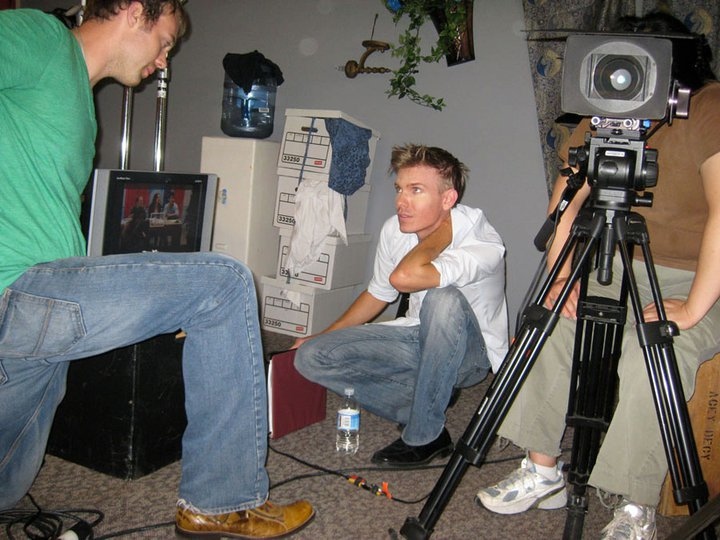
As many of you know, I recently wrote and directed an original web series called, “Dumbass Filmmakers!” The show runs 68 minutes over 12 episodes, so for all practical purposes, I got a great crash course in what it’s like to write and direct a feature film.  “Inside-Out, Outside-In” is now scheduled for a mid-January start, so the time is right to look at what I did right…and what I learned…in the process of making my first long-form film project.  Let’s start with the good decisions I made.

1. Investing in Rehearsals.  I don’t know how many times I’ve heard directors say that the first time they heard the actors say the lines to each other, they were on set rolling the first take. The magic of the “first take – unrehearsed” has a sort of legendary history with some directors, but I made a far different choice with “Dumbass Filmmakers!” and I’m glad I did.  All too often, those directors have the luxury of a more relaxed shooting schedule.  On this project, we had 10 days of production, plus an additional three days of reshoots that were added. My committed team of actors spent weeks rehearsing the material in my apartment and on set before the camera crew showed up. And I’m glad they did. We needed to work out the beats of the material, the blocking and some natural acting challenges that come up AHEAD of time. Once it came  time for production, we were much, much more efficient on set because we had rehearsed and people knew their blocking and business ahead of time. If other first-time  directors want to try the magic of the “first take – unrehearsed,” I’m all for it. But in this case, our shooting schedule didn’t provide for a risk like that and I’m glad I made the call to invest in preparation.  And, yes, my pug Romeo saw all the rehearsals go down.

2. Writing three-dimensional characters and demanding that actors play them that way, even though the show is “comedy.” The biggest trap I see with actors in comedy is that they start judging their characters as fools or losers and make fun of their own character while they’re playing the part. Any actor who auditioned for the show with this mentality didn’t get very far. I’m not interested in Saturday Night Live, sketch-style acting. More than once, actors were in tears sobbing dealing with demons that I wanted to exist for the character. On the whole, I’m satisfied with our results and many people have said they not only found the characters funny, but also recognized them as real people that exist in Los Angeles. I’m proud that we steered towards a more humanistic brand of comedy than a shallow, sketch brand of comedy.

3. Crowdfunding. This may relate more to producing than directing, but the decision to crowdfund part of our budget (made with my producing partner Elizabeth Gordon) was a good one. Most of the nearly $5,000 we raised came from members of my own family, with the largest donation by far coming from my brother Parker. (Special note: It’s pretty cool that my brother – an officer in the Army who just returned from a tour of duty in Afghanistan gave a big chunk of change for his brother to make an LGBT web show). While $5,000 didn’t cover the majority of our expenses, it sure didn’t hurt. And we wouldn’t have gotten any of that money if we didn’t ask. It gave me a heightened sense of confidence to know that my family took the step to write checks to support my creative endeavor, a first for me. Big credit also to Elizabeth for securing some donations from her circle as well. It is not comfortable for most artists to ask for support, but sometimes it pays off.

4. Creating an amazing post-production team. I call special attention to the post-production team because, as a director, these people are most closely aligned with you as you take a raw product and refine it towards your vision until a finished piece exists. So it’s extremely important to find amazing people to help you with this part of the process.  I lucked out across the board with our two editors Chris Friend and James Lee Hernandez, our composer Sergio Jiminez Lacima, our post-audio supervisor David J. Kruk and our colorist Sam Mestman. All these guys not only expertly did their specific job, but also supported my vision of the piece by listening to what I wanted and then finding a way to translate that into how the show sounded, its editing rhythm, its look. And because they could see so many individual pieces of the project, they all had an understanding of the scope of “Dumbass Filmmakers!” and the difficulty of its development in post. That empathy was key for me in surviving the post-production process, because by then, you’re so tired and so overwhelmed that you’re not sure you can keep moving forward on the project. Then you show up at someone’s studio or an apartment with blinged-out computers. A techie geek or hipster dude (or both) brings you a cup of coffee and you get to work. That unspoken camaraderie was key to the success of the show and I gratefully acknowledge it here. You’ll be working with your post-production team a whole lot more than the crew on production, so be sure they are people that you respect, trust and, yes, like (and vice versa). It’s very important.

5. Putting my life on hold to finish the project. There came a time in the last 120 days of post-production that I had to put my entire life on hold to finish the project. No more dates. No meditation. No day jobs. No meetings. Just at least 80-90 hours of work every single week without a day off until it’s done. While it’s true that sometimes balance is necessary, some of the people who spout that off have never finished a project of any scope. I offer a different point of view. There comes a time with your project when it’s like a wild animal or bear that you must either wrestle down to the ground or let it go free. Quit Facebook. Quit working out. Quit your day job if you have to. Run the risk that you’ll piss off your girlfriend/boyfriend/family/friends and just FINISH THE F’ING THING. Once you do, you will emerge a new man (or woman) and feel proud of yourself. Somehow, the other stuff will come back into balance eventually. Hollywood is not for wimps. So don’t be one. I’m extremely proud that – whatever its flaws – my 68-minute project has been completed. And yeah, willpower, endurance and a conscious decision to forgo everything else were a big part of the reason why.

Five Things I Could’ve Handled Better

1. Anxiety over Technical Issues – I’m the guy that panics when it looks like a drive is failing to fire up or a media file shows up offline in Final Cut Pro. But remembering that even technology is imperfect is key to managing your stress in production and post-production. Sometimes, tech stuff goes wonky. Deal. By the end of post-production, I learned that 99% of the time if a drive doesn’t show up when you turn on the computer, let’s just unplug it and restart and it’ll probably be fine. Bringing that stress to yourself and others doesn’t help anyone.

2. Cutting too early. On set, you get so caught up in the rush of trying to finish shots that all too often, you cut too early. With digital cameras, it really doesn’t cost you anything to let the camera run a few extra moments. And sometimes it’s those moments after an actor thinks they’ve “finished” their business that things actually get interesting. More than once, my editor yelled at the monitor, “Why did you cut? Why did you cut? What happens right after this? It’s getting so interesting!” I cut because, on set, you’re in an adrenaline mode, so subtle moments of humanity that occur are sometimes lost to you. Next time, for safety’s sake, I’ll let the camera roll a little bit longer than you think you need to.

3. Not Structuring the Show Properly. The biggest flaw in “Dumbass Filmmakers!” is the structure. I originally wrote the series as four discrete 22-minute episodes. We decided to basically shoot two-and-a-half of those episodes then “worry about it in post” to break it up into webisodes. This decision caused me the single most amount of pain than any other decision associated with the show. Learn from my dumbass-ness!!! Write for the medium you’re in. If you’re making webisodes, write a five-minute webisode. Now, I’m satisfied we did the best we could to make something interesting out of the structure. But on the feature film, I’m so grateful that it’s been written as a feature, will be shot as a feature and edited as a feature. This was the biggest pain in the ass and remains the biggest flaw in the show.

4. Not playing with all the tools available ahead of time. In my defense, we had a compact schedule rolling from our short film “Winner Takes All” to this project. But I wish I’d taken more time to just play with all the tools available to me as a director ahead of time. From the Canon 5D to the Gorilla software to MindNode to Final Cut Studio, I wish I’d spent more time fooling around with these valuable creative tools so that learning would take place before the stressful schedule of making a film project.

5. Being Daddy. (It’s a boy! It’s a girl! It’s twins! It’s everybody!) Anthony Hopkins famously said, “Most actors are damaged goods.” Nina Foch, the famed acting coach whose pupils included Sean Penn, theorized that the only reason someone becomes an actor is because they are convinced that at least one of their two parents didn’t love them. Without insulting any of my amazing actors, I want to say I agree with both Hopkins and Foch. What’s more, many other creative artists in other fields related to filmmaking are similarly damaged. And when you strap on that title of “Director,” guess who is the authority figure? Guess who, consciously or unconsciously, becomes their Daddy (or Mommy as the case may be) that didn’t love them? YOU DO. And what’s more, most artists are completely unconscious of the fact that they’re playing out their unresolved parental issues (on top of their stress of juggling day jobs, acting class, friends and family). And here’s the kicker…guess what? I’m an actor, too. So I’m doing the same thing! Projecting my unresolved pain and needs onto others and wanting attention and love to fix it. However, with tight schedules, there’s really not a lot of time for a director to get caught up in being triggered but it is also, for better or worse, inevitable. So think of ‘Being Daddy’ as part of the collateral damage of ‘Being Director.’ Sometimes I was able to channel it into my own work. Sometimes I let it throw me. But on this project, there was a sense of shock that this type of projection was even happening. My head kept saying, “It SHOULDN’T be this way. It DOESN’T HAVE to be this way.” Wrong. It does have to be this way. Artists are vulnerable, damaged people and when you come together to make a movie, that’s a lot of vulnerable, damaged people in the same space (including you!). So expect yourself and others to act like triggered teenagers from time to time and roll with it the best you can. It will be this way on EVERY SINGLE PROJECT THAT YOU MAKE (that’s in any way based in the truth, at least). If you handle it properly, you and your cast may even get some healing out of it. With “Dumbass Filmmakers!” I believe we emerged from the process as better human beings (and I say again, I really do love all my actors on the show and think they’re talented and amazing), but next time it won’t be such a shock that when you deal with emotional terrain, emotions come out…one way or another. It’s normal and to be expected.

Now that I’ve learned some valuable lessons and can build on the momentum of “Dumbass Filmmakers!,” this blog will be shifting pretty much full-time to the making of “Inside-Out, Outside-In.” Hope you will enjoy the ride! And in case you’re curious, here is a peak at the first episode of “Dumbass Filmmakers!”

Hunter Lee Hughes is a filmmaker and actor living and working in Los Angeles and the founder of Fatelink. His current feature film Guys Reading Poems is touring film festivals and this blog is dedicated to the process of making his second feature film, “Inside-Out, Outside-In.” If you enjoy the blog, please support our team by following us on Facebook, Twitter (@Fatelink) or Instagram (@Fatelink).

Indie Filmmakers to Google Fiber: THANK YOU!

Tags

, , , , , , , , , ,

Never have I been so jealous of Kansas City.  The genius geeks over at Google decided (presumably for a great reason) to choose Kansas City as the launching pad to test its new Google Fiber technology. According to their site, the technology will allow users to download content from Google Fiber TV channels, Netflix and other sources.  And Google claims that viewers will be able to see HDTV quality over the Internet seamlessly and at rates up to 100 times faster than normal broadband.  It will also include a 1 TB drive that allows you to record up to eight programs simultaneously, in addition to being able to choose from HD channels online like a DVR player.

It’s official. The difference between your computer and your television no longer exists.

Not only does Google Fiber TV sound amazing for the end users (enjoy your head start, Kansas City), it’s even more amazing for today’s crop of rising indie filmmakers. Why? Well, think about this. Traditional Hollywood’s biggest asset has been their huge financial and structural advantage when it comes to the distribution network of theaters, cable channels and sales outlets around the world. How could I – the little guy – get my product next to their product at a multiplex?  How could I – the little guy – negotiate for my project to be on a cable channel when big Hollywood has such a huge competitive advantage? How could I convince stores – and even Netflix – that carry dvd’s to choose my products over the dvd’s of traditional Hollywood?  The old answer was, “I couldn’t.”  The new answer is, “It doesn’t matter.” This huge structural advantage that traditional Hollywood built up? If Google Fiber TV lives up to its billing, that structural advantage of traditional Hollywood just collapsed.

Once Google Fiber takes over (and it will…or, at minimum, something like it), my web show “Dumbass Filmmakers!” will appear in its full HDTV glory at anyone’s fingertip. It will be as easy to find with a Google search as Tom Cruise’s latest film.  And when the audience plays it on their device, it will appear to them on their big screen tv at home, as programming.  Not Internet television programming.  But programming, period. Finally, consuming independent film product will be JUST AS EASY for the audience as consuming Studio-made fare.  So thank you, Google Fiber, for leveling the playing field.

That doesn’t mean that Google Fiber will suddenly introduce a whole new generation of indie filmmakers (although I think it’s possible).  Obviously, big traditional Hollywood still has its second biggest weapon – its ability to generate and use star talent – to draw bigger audiences and more interest to their products. The average consumer of entertainment will be much more drawn to click and watch something they know rather than something they don’t know. However, indie filmmakers have a golden opportunity to take advantage of social media and lower production costs to put themselves in contention. And as the porn industry has shown with its online juggernaut, niche content plays really well online and consumers don’t expect pristine production quality from every product they consume. Indie filmmakers have a much easier time serving niche audiences because they have more freedom to explore subject matter with their lower budgets and, let’s be frank, they are often more authentic as human beings. And that’s a weakness for traditional Hollywood going forward.  You see, they’re used to making “generalist” fare, stuff you can feel comfortable watching with your girlfriend, cousin Joe, grandma and your nephew. So the content has to be general and accessible enough for all to enjoy (or at least not go screaming out of the theater). But success online is much more likely to come from niche fare.  You search online to figure out how to fix a specific problem or join a group online of people with similar interests. You don’t need cousin Joe to like what you’re watching.  After all, you’re watching from the privacy of your own home.  So I predict that filmmakers with a unique appeal to a niche or niches will be very nicely served by Google Fiber and the collapse of computers vs. television into one big computer-television.

So as for Big Traditional Hollywood, this indie filmmakers says,”It’s On.”

Hunter Lee Hughes is a filmmaker and actor living and working in Los Angeles and the founder of Fatelink. His current feature film Guys Reading Poems is touring film festivals and this blog is dedicated to the process of making his second feature film, “Inside-Out, Outside-In.” If you enjoy the blog, please support our team by following us on Facebook, Twitter (@Fatelink) or Instagram (@Fatelink).

Making Lists…and a timeline

Tags

, , , , , ,

Today, I finally returned to tasks relating to Inside-Out, Outside-In after focusing most of my energy on the release of a web series (see below).  The two main tasks were to write down a timeline for the project and begin writing a list of potential talent for a key character.

The timeline existed before – just in my head.  But it did help to write down all the target dates as I go into high gear finding investors and collaborators.  People need to know how much of their time the project is likely to require and when milestones should occur.  I found too that whatever knowledge of film festivals that I retain is giving me a hint of how the film’s schedule might affect its initial release and which festivals may be appropriate to target.

Then, I started a list of actresses to consider for the role of Rose Meresh, a key supporting role in the film.  Making lists of actors – especially at this stage – is a whole lot of fun.  I don’t limit myself based on the actor’s status or how likely they are to do the project.  I just think in terms of the archetypal energy of the character and who might be right for it.  It also helps to crystallize the character in my mind because such a list inevitably brings up one of several ways to go with the character.  By the end of a brainstorming session, I had six or seven names on the list. One is a major movie star household name.  Another is a friend I worked with in a play a few years back. And of course, even this list can barely qualify as rough draft territory.  The casting of other roles could really impact who’s right for the role of Rose.  But she’s one of my favorites in the script, so it’s crucial I know who to approach.  Because I believe that it’s approaching the right people that matters most. If you confidently approach the right actress, you don’t just know who the character is in your GUT, you know how to articulate the essence of the character to other human beings.  And you better! Because you’ll be approaching agents, managers and actors and communicating with them about the character.  Once you’ve approached the right actor, it’s up to the “Casting Gods” whether or not your first choice comes through.  But the process teaches you so much about the character that you’ll be able to make maximum use of the actor who eventually plays the role.

Hunter Lee Hughes is a filmmaker and actor living and working in Los Angeles and the founder of Fatelink. His current feature film Guys Reading Poems is touring film festivals and this blog is dedicated to the process of making his second feature film, “Inside-Out, Outside-In.” If you enjoy the blog, please support our team by following us on Facebook, Twitter (@Fatelink) or Instagram (@Fatelink).

Still on track….

So today I was officially asked, “Are you still writing the feature blog?”  The answer, “YES.”  

My other project – a webseries (which at 68 minutes may as well have been a feature) – premieres in just under two weeks.  So, I’m going a bit nuts finishing that project.  But everything I learned on the webseries will be rolled into the feature…and, soon enough, this blog again.  But in the meantime, I just can’t cheat my current project.  Please stay patient with me and I’ll be back soon! 🙂

In the meantime, here’s the trailer for the series…


Balancing projects

Tags

, , , , , ,

A brief word on balancing projects.  Sometimes you can’t.

For the last several weeks, I’ve been working overtime to prep my first directorial effort – a webseries called “Dumbass Filmmakers!” – for release.  We’re still not finished with the post-audio, the score, the color correction and, of course, the marketing.  It’s been more all-consuming than I anticipated.  And even though I sometimes feel a tremendous amount of guilt at not moving forward every day with the feature….wait….THAT IS RIDICULOUS.  Earth to brain….re-wire!

Sometimes, prioritizing means making a decision that you have no time for something.  Right now, during the thick of this process, I really have no time for the feature.  But that will change within a few weeks.  Just tonight, I finally got the drive delivered to our colorist, also serving as our online editor to close this thing out.  And everything I’m learning directing the webseries applies – in one way or another – to the feature.

So, while I feel terribly guilty to have skipped checking in with you these past two weeks, it was not due to laziness. And that excuse will have to do for my own inner critic as well.

And yes, here is a shameless plug of our teaser trailer for the show.  The 90-second trailer is coming in a few weeks, another project on the near-term horizon. For now, this will have to do! 🙂

Hunter Lee Hughes is a filmmaker and actor living and working in Los Angeles and the founder of Fatelink. His current feature film Guys Reading Poems is touring film festivals and this blog is dedicated to the process of making his second feature film, “Inside-Out, Outside-In.” If you enjoy the blog, please support our team by following us on Facebook, Twitter (@Fatelink) or Instagram (@Fatelink).